
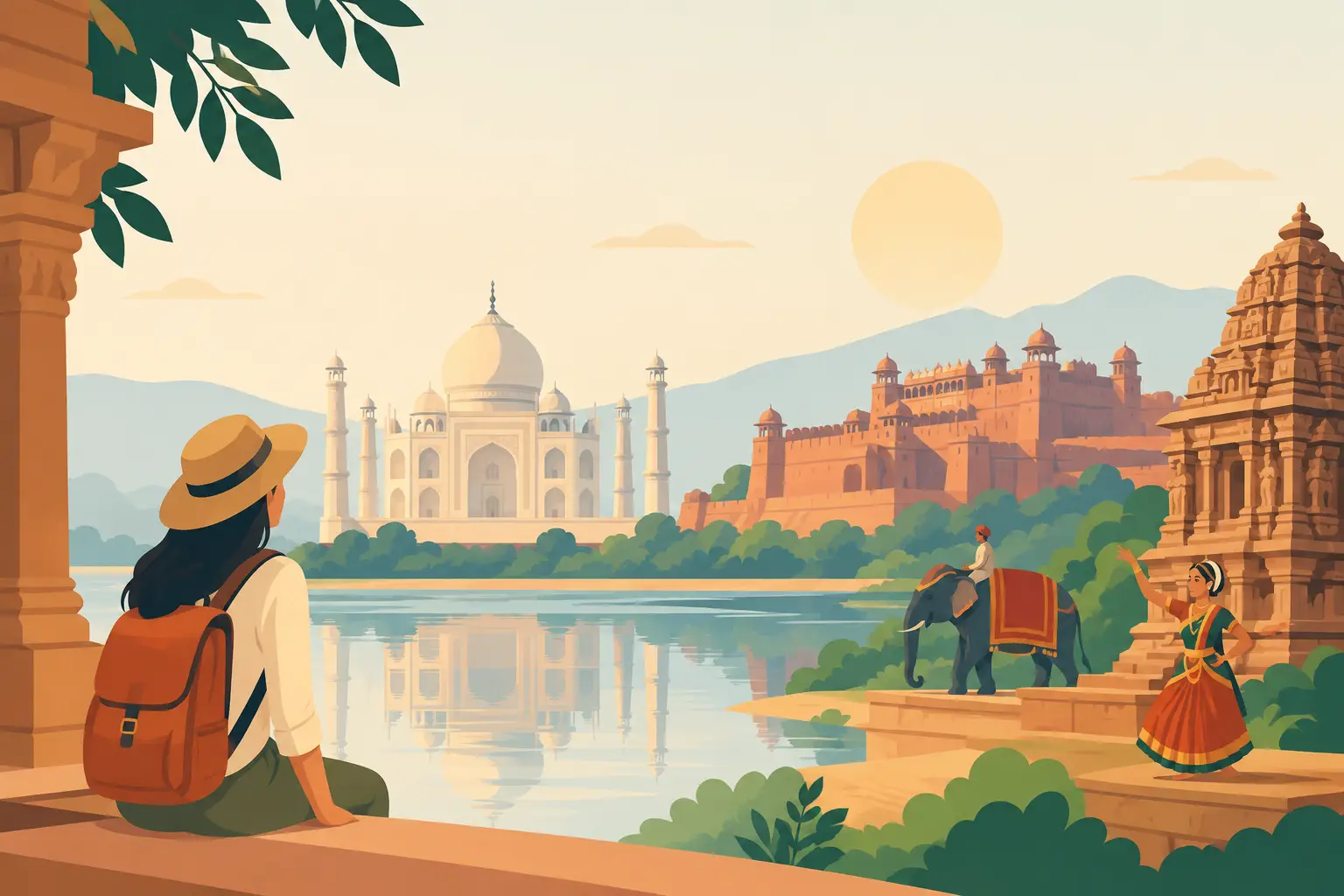
At sunrise on the Ganges, Varanasi is not a monument to be checked off. Bells carry across the water, pilgrims descend the stone ghats, and everyday rituals unfold with a sense of continuity that no guidebook can fully capture. That is the difference between seeing famous places and seeking India’s most meaningful heritage experiences: the goal is not simply to admire the past, but to understand how it remains present.
India rewards travelers who slow down, look beyond the postcard view, and travel with enough context to ask better questions. Its forts, palaces, temples, markets, and sacred cities are extraordinary on their own. Yet their deeper value emerges through local stories, regional food, spiritual traditions, and conversations that connect architecture to the people who still live alongside it.
What Makes a Heritage Experience Meaningful?
A meaningful heritage journey has room for both landmark moments and quieter forms of discovery. Standing before the Taj Mahal at first light matters. So does learning why its marble changes color through the day, hearing the story of the artisans who shaped its intricate inlay work, and understanding the Mughal world that made such an ambitious monument possible.
Context changes the experience. India has been shaped by powerful empires, trade routes, religious traditions, colonial rule, artistic exchange, and countless local identities. A knowledgeable local guide can turn a beautiful building into a vivid human story, while leaving space for your own observations and questions.
The most rewarding itineraries also avoid trying to see everything. India is vast, and each region deserves attention. A well-paced small-group journey creates time to absorb a place rather than rush through it between photo stops. Comfort and thoughtful logistics matter here, especially when navigating busy cities, long travel days, and sites with cultural protocols.
India’s Most Meaningful Heritage Experiences, by Place
Watch the Taj Mahal Become More Than a Photograph
The Taj Mahal is one of the world’s most recognized buildings, and it can also be one of its most misunderstood. It is often reduced to a symbol of romance, but the mausoleum is also a masterwork of Mughal architecture, Persian-inspired garden design, engineering, and devotional art.
A meaningful visit begins early, when the light is softer and the complex feels less hurried. Notice the symmetry of the charbagh garden, the precise calligraphy at the entrance, and the delicate pietra dura stonework in the marble. Then step back from the visual spectacle. The Taj tells a story of imperial power and profound loss, built by Shah Jahan for Mumtaz Mahal in the 17th century.
Agra deserves more than a single overnight stop. Agra Fort provides the political counterpoint to the Taj, revealing the scale and sophistication of the Mughal court. Seeing both places helps travelers understand that the Taj was not an isolated wonder, but part of a powerful capital and a larger cultural legacy.
Hear Living Faith Along the Ghats of Varanasi
Varanasi can feel intense, and that is part of its honesty. One of the world’s oldest continuously inhabited cities, it is sacred to Hindus and deeply tied to ideas of life, death, purification, and renewal. The city asks visitors to observe with humility rather than treat religious life as a performance.
A dawn boat ride on the Ganges offers a quiet introduction to the ghats. From the water, the city reveals a layered rhythm of bathing, prayer, laundry, temple visits, and morning conversation. In the evening, the Ganga Aarti ceremony brings music, flame, and devotion to the riverbank.
This experience benefits greatly from sensitive local guidance. There are places where photography is inappropriate, rituals that deserve distance, and emotional realities that travelers should approach respectfully. Varanasi is not always comfortable, but it is often unforgettable because it feels so immediate and alive.
Walk Jaipur Through Its Crafts and Royal History
Jaipur’s pink facades and grand palaces make it a natural heritage highlight, but Rajasthan’s capital becomes far more compelling when its artistry is part of the story. The Amber Fort, City Palace, and Jantar Mantar observatory reflect the ambition of Rajput rulers and the city’s long-standing role as a center of design, science, and trade.
At Amber Fort, look beyond the hilltop views to the painted halls, mirrored surfaces, and defensive planning of a royal complex built to impress and protect. At Jantar Mantar, the monumental astronomical instruments show how seriously Jaipur’s founders engaged with mathematics and the movement of the heavens.
Then make time for the workshops and food traditions that continue to define the city. Block printing, gemstone work, blue pottery, textiles, and regional cooking are not souvenirs detached from history. They are living skills, often sustained through family knowledge and generations of practice. A visit to an artisan neighborhood or a thoughtfully chosen local meal can bring Jaipur’s heritage into focus in a personal way.
Find the Human Scale of Rajasthan Beyond Jaipur
Rajasthan’s heritage is not confined to its best-known capital. In smaller cities and rural communities, travelers can encounter stepwells, temple towns, village markets, traditional homes, and the warm hospitality for which the region is known.
Udaipur, with its lakes and palace architecture, offers a more romantic setting and a different pace from Jaipur. Jodhpur’s blue-painted old city and imposing Mehrangarh Fort reveal another side of Rajput history. The right choice depends on your interests and available time. Travelers drawn to architecture may favor Jodhpur, while those who appreciate lakeside scenery, crafts, and a gentler rhythm may prefer Udaipur.
The trade-off is simple: adding more destinations can provide variety, but it can also create too much time in transit. A carefully designed route is usually more satisfying than an ambitious map with no room to linger.
Experience Amritsar With Respect and Openness
The Golden Temple in Amritsar is among India’s most moving sacred sites. Its gilded exterior is striking, particularly at dawn or after dark, but the deeper lesson is one of Sikh values: equality, service, and community.
Visitors can witness these values in the langar, the community kitchen where volunteers prepare and serve free meals to thousands of people regardless of background. Sitting on the floor alongside other guests is a simple but powerful experience. It calls for modest dress, covered heads, and a willingness to follow local customs with care.
Amritsar also carries difficult historical memory. Jallianwala Bagh commemorates the 1919 massacre that became a defining event in India’s independence movement. Visiting with historical context makes space for reflection and avoids reducing a complex city to a single beautiful landmark.
How to Travel Through Heritage With More Care
The difference between respectful travel and superficial tourism often comes down to pace, preparation, and behavior. Dress appropriately at religious sites, ask before photographing people, and accept that some sacred spaces have rules that may limit access. These are not inconveniences. They are part of entering a place on its own terms.
It also helps to arrive with curiosity rather than assumptions. India is not one culture, one language, or one religious tradition. What feels customary in Jaipur may be different in Varanasi, Amritsar, Kerala, or Kolkata. Ask your guide about etiquette, listen to local perspectives, and resist the urge to make quick judgments from a brief encounter.
Small groups can make this kind of travel easier. With fewer people, there is more flexibility to pause for an unexpected festival procession, spend longer with an artisan, or adjust the day when a site is especially crowded. There is also more room for conversation, which is often where a journey becomes memorable.
For travelers who want the reassurance of organized planning without the impersonality of a large coach tour, a carefully curated small-group itinerary offers a strong balance. Atlas Global Tours designs cultural journeys around landmark sites, local insight, and the practical details that let travelers focus on the experience rather than the logistics.
India’s heritage is not waiting behind museum glass. It is in the morning chant by the river, the stone carver’s patient work, the shared meal at a gurdwara, and the stories that change the way you see a famous palace. Leave enough room in your journey for those moments. They are often the ones that travel home with you.