
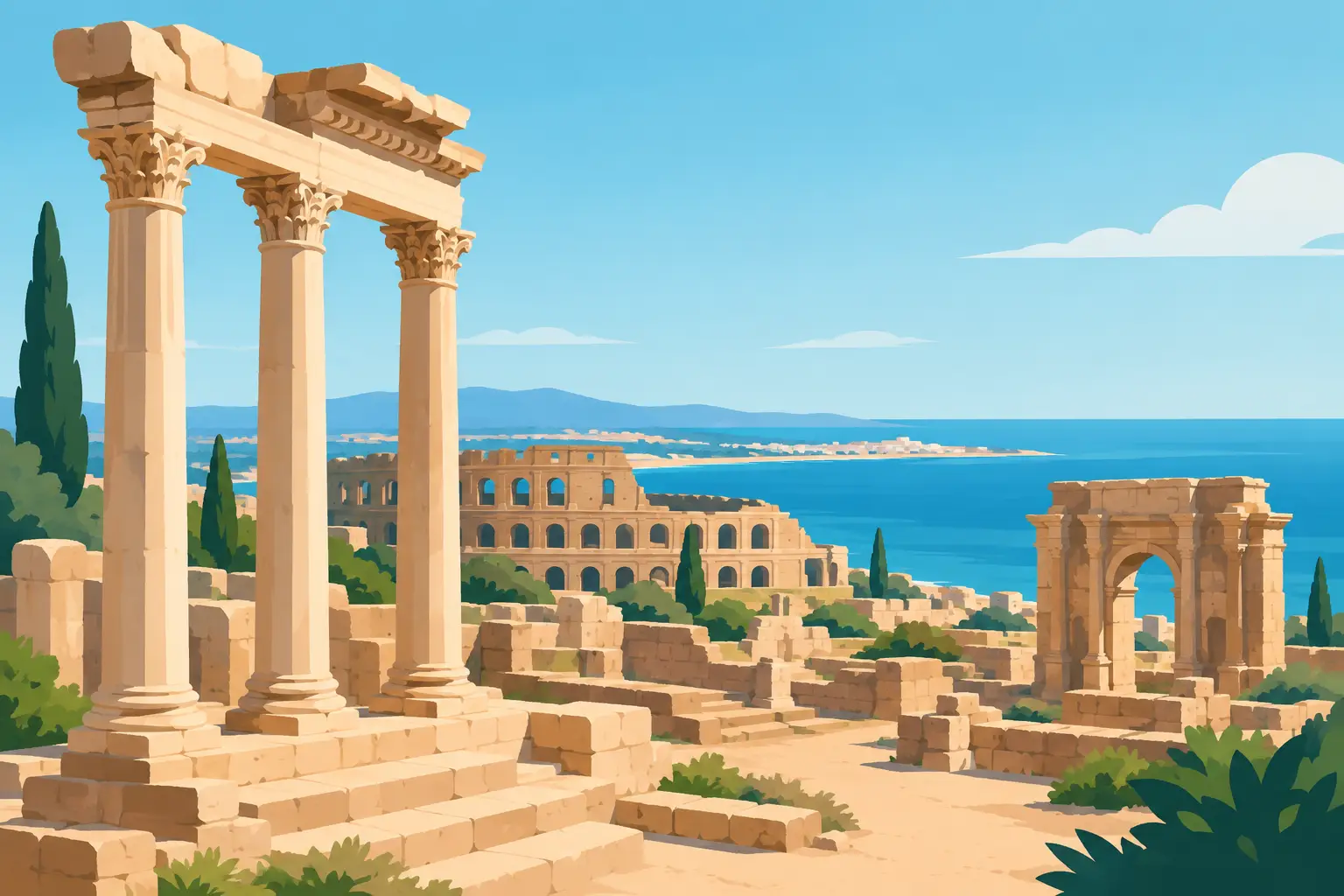
A Roman temple rising above olive groves, an amphitheater that still feels built for a crowd, homes designed with rooms below ground – Tunisia makes ancient history feel unusually close. The top Tunisia Roman archaeology sites are not isolated ruins reached after exhausting detours. Many can be thoughtfully combined into a rewarding journey that also includes medinas, coastal towns, North African cuisine, and the generous local perspective that gives stone walls their human story.
For culturally curious travelers, Tunisia offers one of the Mediterranean’s richest Roman landscapes with far fewer crowds than Italy’s headline sites. The best route depends on your interests and pace. Some travelers want grand monuments; others are drawn to the intimate details of daily life. A well-planned small-group itinerary creates room for both.
Why Tunisia’s Roman Sites Feel Different
Roman North Africa was not a remote edge of the empire. It was a prosperous, agriculturally powerful region whose cities supplied Rome with grain and olive oil. Local communities adopted, adapted, and shaped Roman urban life, creating a distinct blend of imperial planning, North African traditions, and later Christian heritage.
That context is visible on the ground. At Tunisia’s archaeological parks, you may walk through bath complexes, marketplaces, villas, temples, theaters, churches, and tombs in the same afternoon. The monuments are compelling on their own, but an experienced local guide helps reveal what is easy to miss: the water systems beneath a bathhouse, the social hierarchy embedded in a house plan, or the political message carved into a triumphal arch.
The Top Tunisia Roman Archaeology Sites
Dougga: A Complete Roman City in the Hills
Dougga, known in antiquity as Thugga, is often the site that stays with travelers longest. Set high in the hills of northwestern Tunisia, it is not dominated by one monument. Its power comes from the extraordinary completeness of the city itself.
The Capitoline Temple, dedicated to Jupiter, Juno, and Minerva, commands the forum with a formal grandeur that remains remarkably intact. Nearby, the Roman theater looks across a broad green landscape, making it easy to imagine civic ceremonies and performances unfolding here nearly two thousand years ago. Dougga also preserves baths, houses, a market, temples, and traces of everyday infrastructure.
The trade-off is distance. Dougga requires a purposeful excursion rather than a quick stop from Tunis, but the setting and depth of the site make the journey worthwhile. Wear supportive walking shoes, as paths can be uneven and the terrain is hilly.
El Jem: The Amphitheater That Reframes Roman Africa
El Jem’s massive amphitheater is one of the most arresting Roman monuments anywhere in the world. Built in the third century, it rises from the modern town with a scale that surprises even travelers familiar with the Colosseum. Its stone corridors, tiered seating, and underground passages offer an unusually direct view of how a Roman arena functioned.
It is tempting to think only of gladiatorial spectacle here, but El Jem also speaks to the wealth and ambitions of Roman Thysdrus. The city prospered through olive oil production, and its leaders had the resources to commission an arena of exceptional size.
El Jem is visually dramatic and relatively easy to understand, making it an excellent choice for first-time visitors to Tunisia. It can be hot, however, particularly from late spring through early fall. Early morning or later afternoon visits are more comfortable and often more atmospheric.
Carthage: Layers of Empire Beside the Mediterranean
Carthage is best approached as a landscape rather than a single ruin. The city is famous for its Phoenician and Punic past, especially its long rivalry with Rome, but it became one of the Roman Empire’s great North African centers after its rebuilding. Today, archaeological remains are dispersed across a beautiful coastal suburb of Tunis.
The Antonine Baths are the standout Roman stop. Their vast foundations and sea-facing position suggest the scale of the public complex that once stood here. Elsewhere, visitors can explore the Roman theater, villas, cisterns, and the wider urban fabric of a city that was repeatedly transformed over centuries.
Carthage rewards context more than hurried sightseeing. Because the remains are spread out and some are fragmentary, a guide and a well-organized route matter. Pairing the visit with nearby Sidi Bou Said and Tunis creates a fuller day, connecting ancient Mediterranean history with the living character of contemporary Tunisia.
Bulla Regia: Roman Homes Below Ground
Bulla Regia offers a perspective few Roman sites can match. Its wealthy residents built parts of their homes underground, using subterranean rooms to manage the fierce summer heat. Walking through these lower levels makes Roman domestic life feel tangible in a way that formal temples and public squares cannot.
The site preserves beautiful floor mosaics, courtyards, baths, and rooms that reveal how architecture responded intelligently to climate. Rather than treating Roman urbanism as a fixed model imported from Italy, Bulla Regia shows adaptation in action.
This is a quieter, more reflective site than El Jem. It is ideal for travelers who enjoy archaeology beyond the biggest landmarks and appreciate a guide who can bring modest-looking walls and mosaic fragments into focus. Conditions are more rustic than at heavily visited attractions, so it is best included as part of a carefully paced day.
Sbeitla: Temples, Forums, and Early Christian Tunisia
In central Tunisia, Sbeitla preserves the monumental heart of ancient Sufetula. Its most memorable feature is the triple-temple complex at the forum, where separate temples dedicated to Jupiter, Juno, and Minerva create a striking architectural composition. The site’s broad streets, gateways, baths, and public buildings make the city’s Roman plan easy to read.
Sbeitla also opens a window into Tunisia’s transition from Roman rule to the Christian and Byzantine eras. Churches and later structures show that this was not a city frozen at one moment in time. It continued to evolve as political and religious life changed across North Africa.
Because Sbeitla sits inland, it works best for travelers willing to see more than Tunisia’s coast. The reward is space, strong preservation, and a sense of discovery that is increasingly rare at Europe’s most famous ancient sites.
Thuburbo Majus: The Everyday Texture of a Roman Town
Thuburbo Majus, south of Tunis, is a valuable complement to Tunisia’s grander ruins. Its forum, Capitol, temples, houses, and baths reveal the structure of a thriving provincial town. The site is especially appealing for travelers interested in how Romans socialized, worshiped, traded, and maintained civic life beyond the empire’s largest cities.
The baths are a particular highlight, with visible traces of the changing temperatures and functions that organized the bathing experience. A visit here benefits from unhurried interpretation. Without it, the site can appear less spectacular than Dougga or El Jem; with it, the details reveal a remarkably sophisticated urban community.
How to Build a Meaningful Roman Tunisia Journey
The strongest itinerary does not try to collect every ruin in a few days. Tunisia’s sites are spread across the country, and road time deserves to be balanced with proper time on location. For many travelers, a route that combines Tunis and Carthage, Dougga or Bulla Regia in the north, then El Jem and Sbeitla farther south creates a satisfying range of experiences.
Season matters. Spring and fall offer comfortable temperatures for long walks among exposed ruins, while winter can be pleasantly quiet, though weather may be variable. Summer brings intense heat, especially inland. It can still work with early starts, shaded breaks, and realistic expectations, but travelers who prefer a gentler pace may find shoulder season more enjoyable.
Small-group travel is particularly well suited to archaeology in Tunisia. With fewer people, it is easier to hear a guide, ask questions, adjust the day around heat or energy levels, and pause where a site deserves more attention. At Atlas Global Tours, groups are capped at 10 travelers so the experience can remain personal while the logistics – transportation, timing, local insight, and cultural context – are handled with care.
Come for the Monuments, Stay for the Perspective
Tunisia’s Roman ruins are not a substitute for Rome. They tell a different and more revealing story: an empire shaped far beyond its capital, in cities where North African prosperity, local ingenuity, and Mediterranean exchange met. Give these sites the time they deserve, and the most lasting memory may be not one famous monument, but the moment you realize how much of ancient history was happening well beyond Italy’s shores.