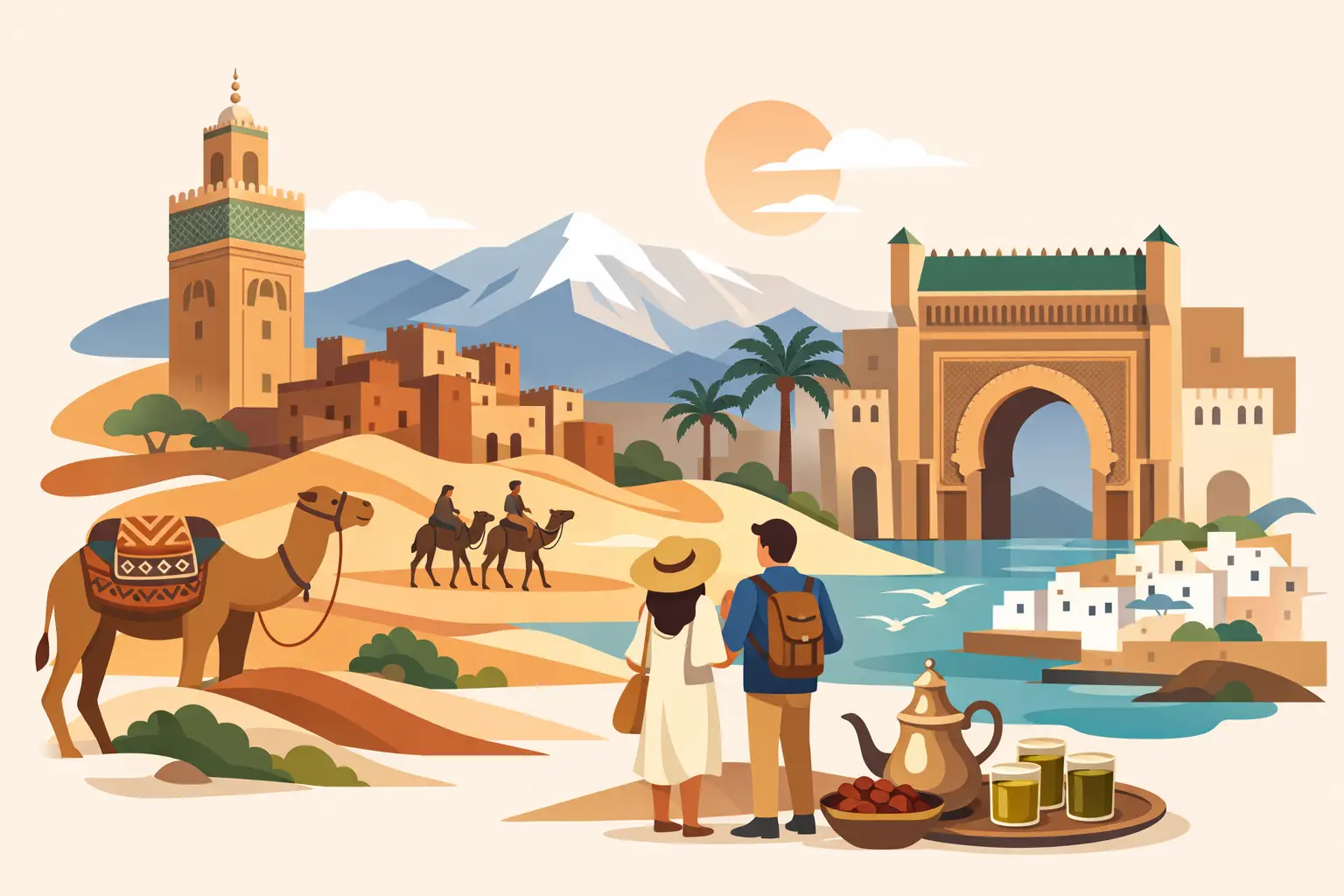
The call to prayer rising above Fes at dawn, the scent of cedar in an artisan workshop, and mint tea shared beneath desert stars can all belong to the same journey. This Morocco cultural trip example shows how a thoughtfully paced 10-day itinerary can move beyond landmark collecting and create real context for the country’s layered history, living traditions, and everyday hospitality.
Morocco rewards travelers who slow down. Its imperial cities, mountain communities, Atlantic ports, and Saharan landscapes are dramatically different, yet connected by Amazigh heritage, Arab influences, Jewish history, Andalusian artistry, trade routes, and family-centered customs. The right route gives each of those stories room to breathe while keeping the logistics comfortable and well organized.
Why 10 Days Works for a Cultural Journey in Morocco
Ten days is long enough to experience Morocco as more than a sequence of photo stops. You can spend meaningful time in Marrakech and Fes, cross changing landscapes toward the desert, and still include smaller encounters that reveal how people live, cook, create, and welcome guests today.
A shorter itinerary can work if your priority is Marrakech and the Sahara. But it often means long driving days and limited time inside the medinas, where the best experiences are rarely scheduled to the minute. Two nights in key destinations make a major difference: you can explore with a local guide, then return later at a gentler pace to revisit a market stall, museum, café, or neighborhood that caught your attention.
For most U.S. travelers, a private driver and knowledgeable local guides also remove the friction of navigating unfamiliar roads, medina lanes, language differences, and changing regional customs. That structure is not about insulating yourself from Morocco. It is what makes deeper engagement feel relaxed rather than rushed.
A 10-Day Morocco Cultural Trip Example
Days 1-2: Marrakech – Craft, Cuisine, and Living History
Begin in Marrakech, a city that can feel exhilarating from the first moment. Its ochre walls, palm-lined avenues, tiled courtyards, and busy souks create a vivid introduction, but Marrakech deserves more than a quick pass through Jemaa el-Fnaa.
A guided walk through the old medina provides orientation and context. Rather than treating the souk as one large shopping maze, learn how different sections developed around trades such as metalwork, leather, spices, textiles, and woodworking. Visit a traditional riad or historic school to understand the geometric design, plasterwork, and mosaic tile that shape Moroccan architecture.
Leave time for food. A cooking experience, ideally one that begins with market shopping, offers a practical window into Moroccan hospitality. Tagines and couscous are familiar names, but the details matter: preserved lemon, ras el hanout, local olives, seasonal vegetables, and the ritual of sharing a meal. In the evening, the energy of the main square is worth experiencing, especially with a guide who can explain its role as a gathering place rather than simply an attraction.
Day 3: Into the High Atlas and Ait Ben Haddou
The route east from Marrakech reveals why Morocco is best experienced overland. The road climbs through the High Atlas, where switchbacks open onto valleys, terraced fields, and villages built from earth-toned stone. This is an opportunity to see the country beyond its famous cities and to learn about Amazigh communities whose culture is central to Morocco’s identity.
A stop in a mountain village can be especially meaningful when it is handled respectfully. The goal is not to peer into private lives, but to share tea, hear local perspectives, and understand the realities of rural life in a demanding landscape.
Later, visit Ait Ben Haddou, a historic fortified village near the old caravan routes. Its earthen architecture is visually striking, but its greater significance lies in how it illustrates southern Morocco’s building traditions and trade history. An overnight nearby keeps the day manageable before the longer journey toward the desert.
Days 4-5: The Sahara – Desert Traditions and Quiet Space
Travel through the Dades or Todra Gorge region, where dramatic rock formations and palm-filled oases interrupt the arid landscape. These valleys have supported settlement for centuries, and their kasbahs, irrigation systems, and agricultural plots tell a story of adaptation as much as beauty.
By late afternoon, reach the edge of the Erg Chebbi dunes near Merzouga. A camel ride can be a memorable part of the arrival, though it should be optional. Some travelers prefer a 4×4 transfer to camp, particularly if mobility or comfort is a concern. A well-designed desert stay balances atmosphere with practical details such as comfortable bedding, private facilities where available, and clear expectations about the setting.
The real value of a desert night is not the camel ride itself. It is the shift in pace. Listen to local music around the fire, watch the changing colors of the dunes, and step away from the usual stream of information and screens. The next morning, sunrise over the sand is simple, quiet, and often the moment travelers remember most clearly.
Days 6-7: Fes – Morocco’s Intellectual and Artisanal Heart
The drive to Fes is substantial, so breaking it up with carefully chosen stops matters. You may pass through cedar forests near Ifrane and the Middle Atlas, where the landscape feels unexpectedly green and alpine. This transition is part of the experience: Morocco is not one uniform desert scene.
Fes invites curiosity. Its ancient medina is dense, intricate, and alive with commerce, faith, scholarship, and craftsmanship. A local guide is particularly valuable here, not only for navigation but for interpretation. You can visit the exterior of historic religious institutions, see the famed tanneries from a designated viewing point, and meet artisans working with zellige tile, brass, textiles, or leather.
Cultural respect is essential in Fes. Some religious spaces are not open to non-Muslim visitors, and a good itinerary treats those boundaries as part of understanding the destination. There is still a great deal to see and learn through architecture, museums, markets, workshops, and conversations with local specialists.
Set aside unstructured time on the second day. Fes can be intense, and some travelers will want to return to a favorite craft shop while others may prefer a peaceful riad courtyard, a hammam experience, or a visit to the Mellah, the historic Jewish quarter. Flexibility is one of the advantages of traveling in a small group.
Day 8: Meknes and Volubilis – Layers of Empire
From Fes, travel to Meknes, one of Morocco’s imperial cities, known for its monumental gates, granaries, and grand urban planning. It offers a different rhythm from Marrakech and Fes, with fewer crowds and a clearer sense of its royal past.
Continue to Volubilis, the remarkably preserved remains of a Roman city set among rolling farmland. Mosaic floors, columns, and streets show that Morocco’s history cannot be reduced to a single era or identity. Roman, Amazigh, Islamic, Jewish, Andalusian, French, and contemporary influences all form part of the national story.
Spend the night in or near the blue-washed town of Chefchaouen. Its visual appeal is immediate, but its location in the Rif Mountains also makes it a welcome pause after several busy days.
Day 9: Chefchaouen – A Slower Kind of Discovery
Chefchaouen is best enjoyed without an overloaded agenda. Walk the blue lanes early before day visitors arrive, notice the painted doorways and flowerpots, and take time for a leisurely meal. The town is photogenic, but treating it only as a backdrop misses its easygoing mountain character.
This is also a sensible place to reflect on the rhythm of the trip. Cultural travel includes iconic moments, but it also depends on smaller ones: a shopkeeper explaining a textile pattern, a shared plate of pastries, or the sound of conversation drifting through a neighborhood square.
Day 10: Tangier Departure or Return to Casablanca
Depending on flight plans, finish in Tangier or continue to Casablanca. Tangier offers a compelling final perspective, shaped by its position between Africa and Europe and its long history as a port city. Casablanca is more practical for many international departures and can include time for the Hassan II Mosque exterior or a final seafood lunch by the Atlantic.
What Makes This Itinerary Feel Culturally Meaningful
The difference between a sightseeing route and a cultural journey is intentionality. It is not enough to sleep in a desert camp or walk through a medina. Experiences become more meaningful when travelers understand where they are, who they are meeting, and how to participate respectfully.
That means choosing locally rooted guides, allowing time for real conversations, and avoiding visits that turn communities into displays. It also means accepting that Morocco may challenge expectations. The call to prayer, bargaining culture, traffic in the medinas, and directness of market life can feel unfamiliar at first. With patient guidance and a small group, those moments become part of the learning rather than a source of stress.
Planning Details That Protect the Experience
Morocco is generally welcoming and rewarding for organized travel, but thoughtful preparation improves every day. Spring and fall offer comfortable weather for most regions, while summer can be very hot in Marrakech and the Sahara. Winter brings cooler evenings and possible snow in the mountains, though it can be an excellent season for travelers who prefer fewer crowds.
Dress modestly in towns and religious settings, carry layers for mountain and desert temperatures, and wear shoes suited to uneven medina streets. Ask before photographing people, particularly in rural areas and artisan workshops. A few words of Arabic or French are appreciated, although guides can bridge communication with ease.
For travelers who want cultural depth without the pressure of managing every transfer, hotel check-in, ticket, and route decision, a small-group journey offers welcome peace of mind. Atlas Global Tours keeps groups capped at 10 travelers, creating room for personal attention, local insight, and the flexibility to let meaningful moments take their proper place.
The best Morocco itinerary is not the one that covers the most ground. It is the one that leaves you with stories connected to people, places, and traditions – and enough time to let those stories stay with you long after the journey ends.