
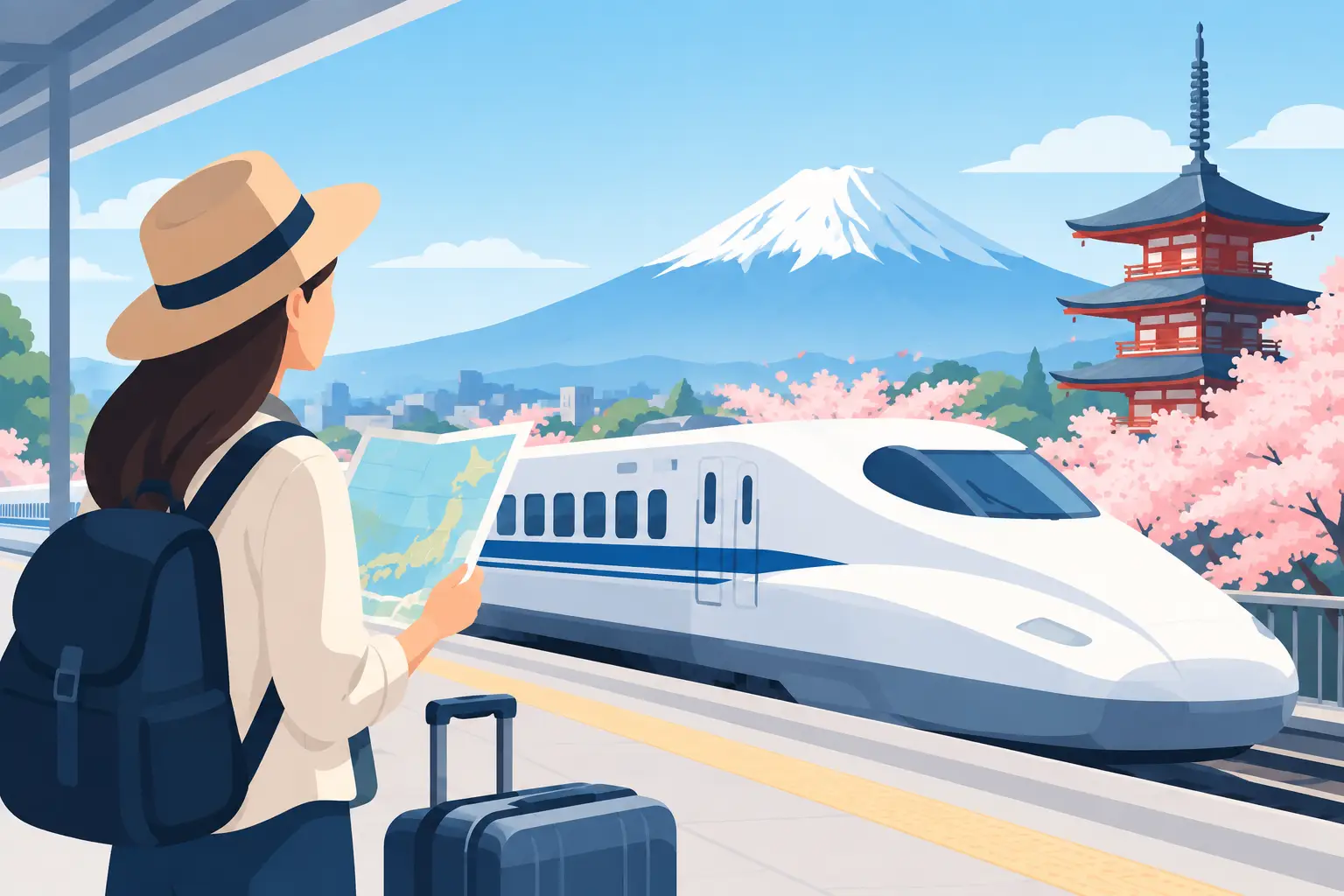
Japan’s rail network can carry you from Tokyo’s neon-lit neighborhoods to a quiet Kyoto temple garden in a single morning. That freedom is remarkable, but it also makes it easy to overpack an itinerary. To plan Japan rail travel well, start by deciding what kind of journey you want to have, not how many cities you can fit onto a map.
For culturally curious travelers, trains are more than transportation. They are part of the experience: the precision of a Shinkansen departure, a bento lunch eaten while Mount Fuji passes the window, and a small local line winding toward an onsen town. With a thoughtful route and realistic pacing, Japan’s rail system makes room for both celebrated landmarks and the unplanned moments that become personal favorites.
Start With a Route, Not a Rail Pass
The Japan Rail Pass is often the first thing travelers research. It can be valuable, but it is not automatically the best choice for every trip. Since pass pricing and rules can change, compare the current pass cost against the point-to-point fares for the exact journeys you expect to take before buying.
A pass may make sense when your itinerary includes several long-distance rail journeys within a short period, such as Tokyo to Kyoto, Kyoto to Hiroshima, and Hiroshima back toward Tokyo. If you are spending most of your vacation in Tokyo, Kyoto, and nearby day-trip destinations, individual tickets or regional passes may be the more sensible choice.
Build your route around two or three overnight bases whenever possible. Tokyo and Kyoto work well for many first-time itineraries, while Osaka, Kanazawa, Hiroshima, Hakone, and Fukuoka can each add a distinct perspective. Changing hotels every night creates unnecessary friction, even when the trains themselves are effortless. A slower rhythm gives you time to notice the character of each place: morning markets, neighborhood restaurants, gardens, craft shops, and the subtle shift in local atmosphere from one region to the next.
How to Plan Japan Rail Travel by Region
Japan rewards geographic logic. A route that moves steadily in one direction will feel calmer than one that repeatedly doubles back across the country.
For a first visit of seven to 10 days, Tokyo, Hakone or the Fuji area, Kyoto, and Osaka offer a strong balance of major sights and regional contrast. Tokyo provides energy, design, food, and contemporary culture. Hakone offers a change of pace with mountain scenery and hot springs. Kyoto brings historic districts, temples, and traditional arts, while Osaka is ideal for lively evenings and regional cuisine.
With 12 to 14 days, consider adding Kanazawa for preserved samurai and geisha districts, Takayama for an intimate mountain-town setting, or Hiroshima and Miyajima for history and reflection. These additions should serve your interests, rather than simply fill available days. A traveler drawn to architecture and gardens may linger in Kyoto and Kanazawa; someone interested in food culture may give Osaka and Fukuoka more time.
The key trade-off is simple: every additional destination offers variety, but it also costs you check-in time, station navigation, luggage handling, and the chance to settle into a place. For most travelers, depth is more memorable than a crowded checklist.
Understand the Train Types Before You Book
The Shinkansen, Japan’s high-speed train, connects many major cities with extraordinary reliability. It is fast, comfortable, and generally easier than flying when you factor in airport transfers and security time. On busy routes, it also gives you a more graceful view of the country than an airplane window can provide.
Not every fast-looking train is included in every rail pass, and some services require an additional fare or have different reservation rules. Confirm the conditions for your specific pass and train before finalizing plans. This is especially relevant on the popular Tokyo-Kyoto-Osaka corridor, where several Shinkansen service types operate.
Regional and local trains are equally useful, particularly for day trips. They may stop more often and take longer, but they reveal a quieter side of Japan. The journey to Nara, Nikko, Kamakura, Arashiyama, or a rural onsen town can be as rewarding as the destination when you leave enough time to travel without rushing.
Reserve Seats for the Journeys That Matter Most
Japan’s trains are impressively organized, but popular travel periods deserve advance attention. Reserve seats for long-distance journeys during cherry blossom season, autumn foliage season, Golden Week, year-end holidays, and major festival weekends. Families, couples, and travelers carrying larger bags will appreciate knowing where they will sit before arriving at the platform.
On ordinary days, unreserved cars can be perfectly practical. Still, a reserved seat offers peace of mind if you are traveling on a schedule, making a hotel check-in, or connecting to a guided activity. Window seats are especially worthwhile on scenic routes and when traveling toward Mount Fuji, though weather conditions always determine whether the mountain appears.
Luggage deserves its own plan. Compact suitcases are much easier in stations, on escalators, and in crowded urban areas. For oversized bags, certain Shinkansen routes require advance reservations for designated luggage space. Another comfortable option is luggage forwarding between hotels. Sending a larger suitcase ahead can turn a one-night stop into a far more relaxed experience, leaving you with only an overnight bag for the train.
Give Yourself More Time Than the Timetable Suggests
The rail timetable may say a connection takes 10 minutes, but that does not mean it will feel easy after a transpacific flight or with unfamiliar station signage. Major hubs such as Tokyo, Shinjuku, Shinagawa, Kyoto, Osaka, and Umeda are large, multi-level environments with several rail operators and exits.
Allow 20 to 30 minutes for important transfers, especially early in your trip. Build in additional time if you need to collect tickets, find a reserved-seat car, purchase food, or travel with luggage. This is not wasted time. It is the margin that lets you arrive composed rather than frustrated.
Use station names carefully. Some cities have several stations with similar names, and a hotel’s nearest station may not be the city’s main hub. Before departure, save your hotel address in Japanese and note which exit is most convenient. A little preparation at this stage can spare you a long walk in the wrong direction.
Make Stations Part of the Experience
Japanese stations are practical, but they are also full of small pleasures. Pick up an ekiben, a regional boxed meal designed for train travel, before a longer ride. Browse the food halls in major stations for seasonal sweets, beautifully packaged snacks, and local specialties that change from city to city.
A rechargeable transit card is useful for local trains, subways, buses, and many convenience stores. It reduces the need to calculate individual fares and makes everyday movement easier. Keep some cash available as well, particularly in smaller towns, though card acceptance continues to improve.
Train etiquette is straightforward and considerate. Speak quietly, keep calls off the train when possible, queue where marked, and allow passengers to exit before boarding. These small habits help you move through the system respectfully and comfortably.
When Guided Planning Changes the Experience
Independent rail travel in Japan is entirely possible, but it asks you to make dozens of small decisions each day. Which platform? Which exit? Is this the best neighborhood for dinner? Does this temple need advance entry? For some travelers, that research is part of the pleasure. For others, it can distract from the reason they came.
A thoughtfully designed small-group journey can preserve the freedom and wonder of rail travel while removing the logistical strain. With local guidance, rail journeys become a bridge to deeper experiences: a family-run restaurant beyond the main tourist street, a context-rich visit to a historic district, or enough time in a smaller town to understand its rhythms. Atlas Global Tours approaches Japan with that balance in mind, pairing meaningful cultural experiences with careful coordination and personal attention.
As you shape your route, leave one afternoon unassigned. Take the slower train if the view appeals. Follow the scent of grilled skewers through a station alley. Step off in a neighborhood that was not on your original list. Japan’s railways are exceptionally good at getting you somewhere. The most rewarding trips leave space to be surprised when you arrive.