
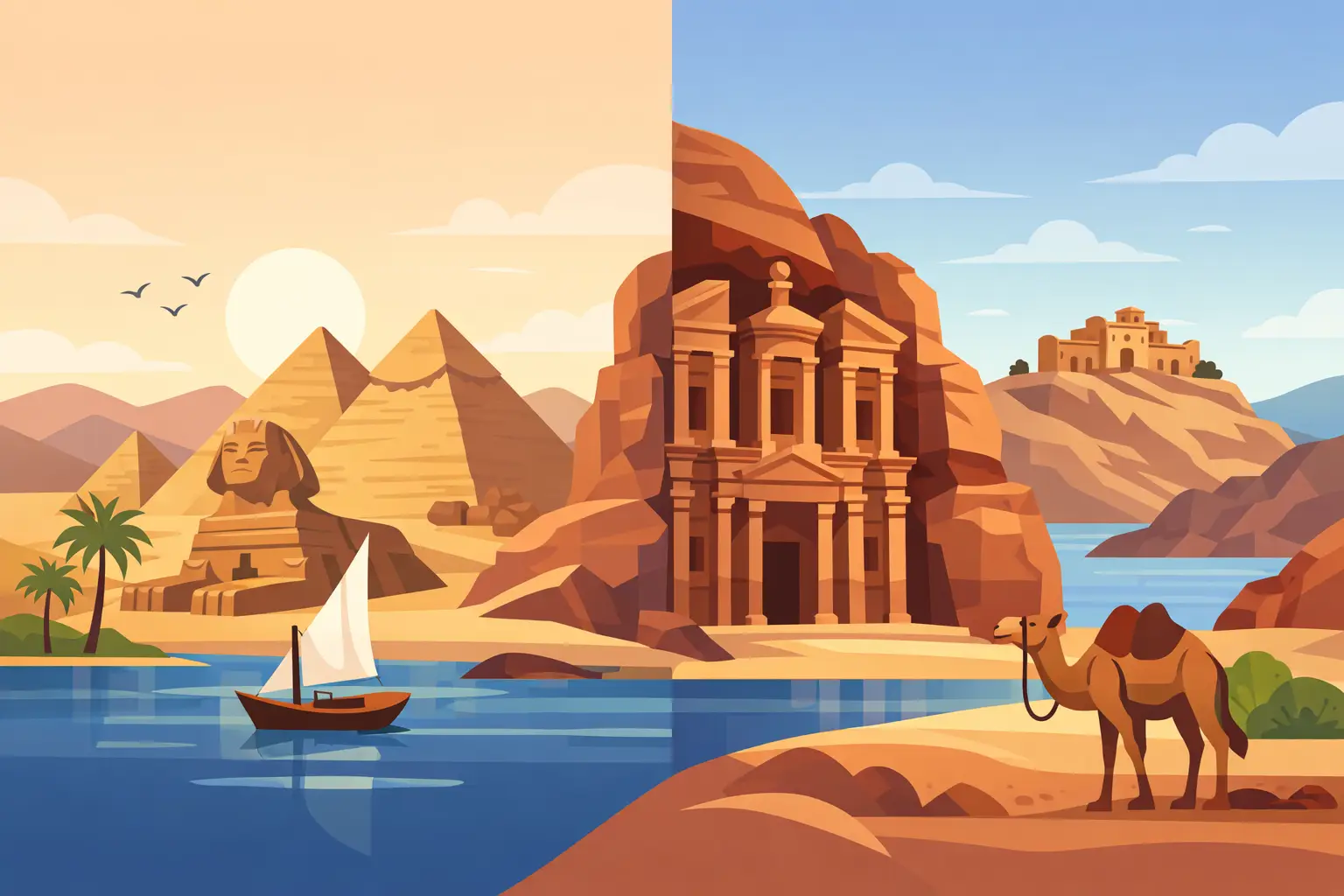
The pyramids are extraordinary, but the moment many travelers remember most may be quieter: sharing tea with a local host, watching the Nile turn gold at sunset, or standing beneath the vast red cliffs of Wadi Rum after the day’s visitors have gone. This Egypt and Jordan itinerary example is designed around those moments, pairing essential landmarks with enough breathing room to absorb the places between them.
For travelers who want cultural depth without managing every flight, transfer, entrance ticket, and border detail alone, 12 days creates a rewarding balance. You will see the ancient capitals and legendary monuments that brought you here, while still having time for local food, conversation, reflection, and the changing landscapes that make these neighboring countries feel so distinct.
Why 12 Days Is the Right Pace
Egypt and Jordan look close together on a map, but they should not be rushed into a one-week sprint. Cairo alone deserves more than a quick overnight stop, and Petra is far more meaningful when you can explore beyond the first view of the Treasury. Add flights, hotel check-ins, road travel, and the practical realities of crossing from one country to another, and a 12-day journey begins to feel sensible rather than indulgent.
This route starts in Cairo, continues to Luxor, then flies onward to Jordan for Amman, Petra, Wadi Rum, and the Dead Sea. It avoids overly long drives in Egypt and leaves the most scenic road travel for Jordan, where distances are manageable and the journey itself becomes part of the experience.
A shorter itinerary can work if you focus only on Cairo, Luxor, Petra, and Wadi Rum. However, it will involve fuller days and fewer unplanned discoveries. If you have 14 or 15 days, consider adding Aswan and Abu Simbel in Egypt, or an extra day in Petra for a longer hike. The best choice depends on your energy, interests, and how much you value a slower pace.
A 12-Day Egypt and Jordan Itinerary Example
Day 1: Arrive in Cairo
Arrive in Cairo and settle into your hotel before the adventure begins. After a long international flight, resist the urge to pack in major sightseeing. A relaxed welcome dinner is a better introduction to Egypt, offering time to meet fellow travelers, review the journey ahead, and begin adjusting to the rhythm of the city.
Cairo is energetic, layered, and sometimes overwhelming on first impression. Starting with a well-organized arrival and an experienced local team gives you the confidence to enjoy its intensity rather than be distracted by logistics.
Day 2: Giza, the Sphinx, and Saqqara
Begin with the Giza Plateau, home to the Great Pyramids and the Sphinx. These sites are familiar in photographs, but their scale is difficult to understand until you stand beside them. A knowledgeable guide adds essential context, from the engineering of the pyramids to the beliefs that shaped ancient Egyptian burial traditions.
Continue to Saqqara, where the Step Pyramid of Djoser reveals an earlier chapter in pyramid building. Saqqara often feels less crowded than Giza and offers a more contemplative view of Egypt’s architectural ambition. The contrast between the two sites gives the day depth rather than simply checking off famous names.
Day 3: Cairo’s Living History
Today shifts from pharaohs to the many communities that shaped Cairo over centuries. Visit the Egyptian Museum or the Grand Egyptian Museum, depending on current access and operating arrangements, then explore the city’s Islamic and Coptic heritage.
A walk through a historic market brings another side of Cairo into view: spice stalls, brasswork, coffee, textiles, and the everyday exchanges of a city that has been a crossroads for generations. Leave room for a traditional meal and time to talk with your guide. Those conversations often provide the cultural insight no display label can offer.
Day 4: Fly to Luxor and Board the Nile
Take a morning flight to Luxor, ancient Thebes and one of the world’s greatest open-air museums. Flying is the most comfortable use of time here. While overland travel is possible, it can consume a full day that is better spent among Luxor’s temples and tombs.
After settling in, visit Luxor Temple near sunset. Its avenue of columns and monumental statues becomes especially atmospheric as the light softens. A Nile-side dinner offers a gentler close to a day that marks a dramatic change in scenery from Cairo’s urban energy.
Day 5: Karnak and the West Bank
Spend the day with Luxor’s extraordinary ancient landscape. On the East Bank, Karnak Temple rewards unhurried exploration, particularly the vast Hypostyle Hall with its forest of towering columns. On the West Bank, enter selected tombs in the Valley of the Kings and visit the temple of Hatshepsut, one of Egypt’s most compelling rulers.
This is a full day, so thoughtful pacing matters. A small group can adjust around heat, site conditions, and individual interests more easily than a large coach tour. You may want extra time for photography, a quiet break overlooking the Nile, or a closer explanation of the vivid tomb paintings.
Day 6: Luxor to Amman
Travel from Luxor to Amman, typically using flight connections arranged around the most efficient schedule. This is a transition day, and that is intentional. International movement between Egypt and Jordan can involve varying flight times and airport procedures, so an itinerary should allow space rather than promise an unrealistic afternoon of sightseeing.
Once in Amman, enjoy a relaxed evening and a taste of Jordanian hospitality. The city’s food scene is an inviting first introduction, with generous shared plates and flavors that reflect the Levant’s rich culinary traditions.
Day 7: Amman and Jerash
Explore Amman’s Citadel and Roman Theater before heading north to Jerash, one of the best-preserved Roman provincial cities in the region. Its colonnaded streets, plazas, temples, and theaters make it easy to imagine the daily life of a city that once connected trade routes across the Roman world.
Jerash adds an important layer to a Jordan itinerary. Petra may be the country’s global icon, but Jordan’s history reaches well beyond the Nabataean civilization. Returning to Amman in the evening also gives you a chance to experience the capital as a living modern city, not merely a stop between landmarks.
Day 8: Madaba, Mount Nebo, and Petra
Travel south along the King’s Highway, one of Jordan’s most rewarding routes. Stop in Madaba to see its celebrated Byzantine mosaic map, then continue to Mount Nebo, traditionally associated with Moses’ view of the Promised Land. On a clear day, the panorama stretches toward the Dead Sea and beyond.
Arrive in Petra by late afternoon or early evening. There is value in waiting until the next morning for your first full entrance into the ancient city. Anticipation is part of the experience, and a restful night nearby prepares you for a day of walking and discovery.
Day 9: Petra Beyond the Treasury
Walk through the narrow Siq, where sandstone walls rise around you, before reaching Petra’s Treasury. It is an unforgettable arrival, but do not let it become the entire story. Continue through the archaeological valley to see tombs, temples, facades, and the remains of a sophisticated Nabataean city built around trade, water management, and desert resilience.
Travelers with strong mobility and an appetite for a climb may choose to hike to the Monastery. It is demanding, especially in warm weather, but the views and sense of scale are remarkable. Those who prefer a gentler day can focus on the lower trails and take time to appreciate Petra’s details with their guide.
Day 10: Petra to Wadi Rum
Leave Petra for Wadi Rum, a protected desert landscape of sandstone mountains, open valleys, and shifting color. Explore by 4×4 with local Bedouin guides, whose knowledge of the terrain and traditions gives the desert a personal dimension.
An overnight desert camp is not about giving up comfort. A well-chosen camp offers a warm welcome, a satisfying dinner, and the rare pleasure of a night sky with little urban light. The silence of Wadi Rum is one of the journey’s strongest contrasts to Cairo and Amman.
Day 11: Wadi Rum to the Dead Sea
After sunrise in the desert, drive north to the Dead Sea. This is the trip’s exhale. Float in its mineral-rich waters, enjoy time at your resort, and let your body recover after days of walking on ancient stone paths and uneven terrain.
The Dead Sea is also a useful buffer before departure. Rather than ending immediately after a long drive or a major site visit, you have a day to rest, organize photos, and reflect on the people and places that made the journey meaningful.
Day 12: Depart from Amman
Transfer to Amman for your onward flight. Departure timing determines whether there is room for a final breakfast overlooking the water or an early transfer, so it is wise to confirm flight details before finalizing the route.
What Makes This Route Feel More Meaningful
The strongest Egypt and Jordan itinerary example is not one that squeezes in every monument. It is one that gives each place a purpose. Cairo introduces Egypt’s vast historical and contemporary complexity. Luxor brings ancient ritual and royal power into vivid focus. Jordan then broadens the story through Roman cities, biblical landscapes, Nabataean ingenuity, Bedouin traditions, and the restorative stillness of the Dead Sea.
A guided small-group journey is particularly valuable across this route because it balances independence with care. With no more than 10 travelers, there is greater room for questions, flexible pacing, and the kind of local encounters that can disappear on a large bus itinerary. Atlas Global Tours pairs that intimate approach with carefully coordinated transportation, knowledgeable local guides, and clear support throughout the journey.
Before booking, consider your walking comfort, interest in tombs and museums, and tolerance for early starts. Egypt and Jordan reward curiosity, but they are active destinations. Pack comfortable shoes, modest layers for religious and historic sites, sun protection, and an open mind. The best days here are rarely the ones that unfold exactly as expected – they are the ones where a guide points out a small detail, a local story changes your perspective, and a place you knew from history suddenly feels wonderfully present.