
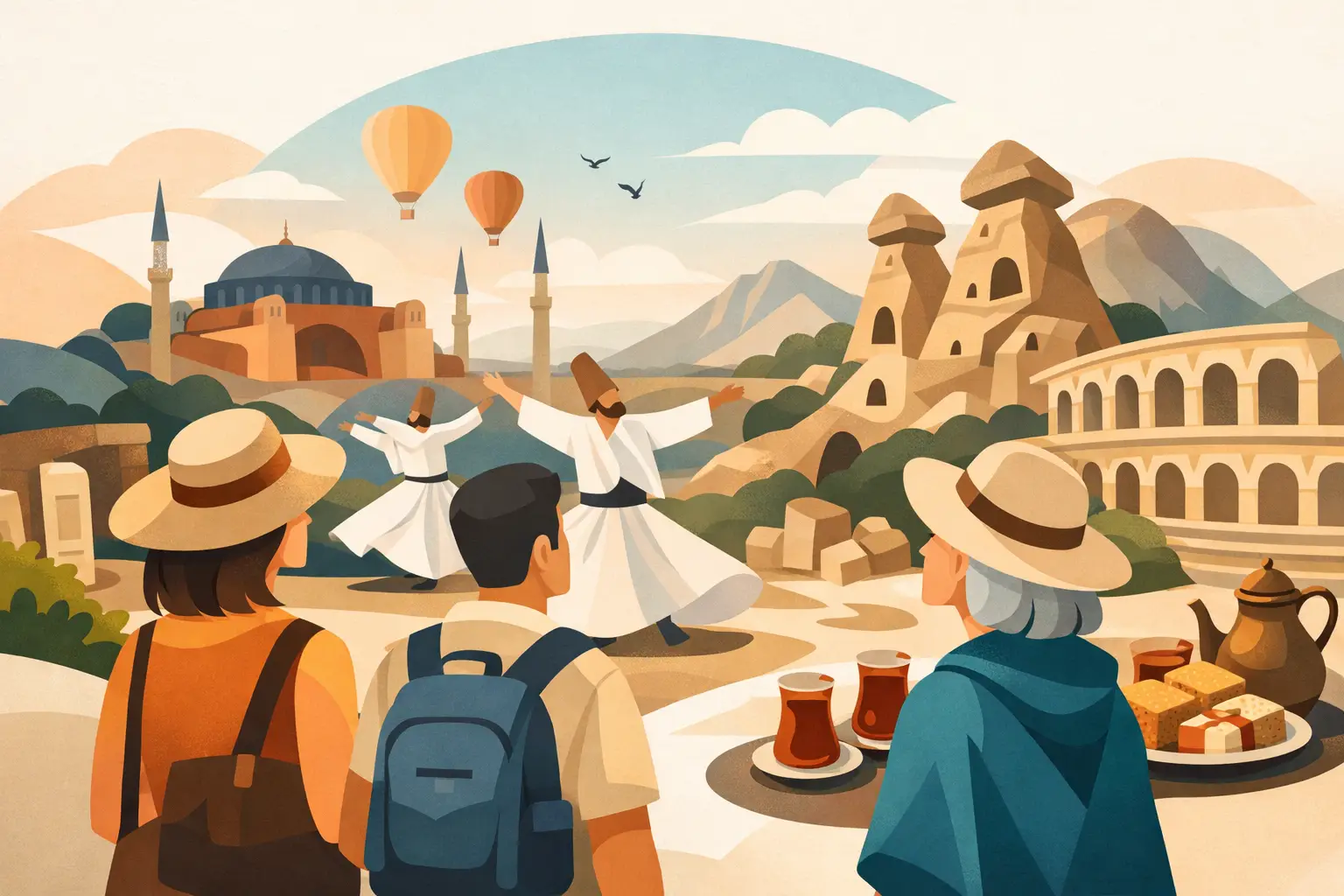
Some trips give you a string of famous sights and a blur of hotel checkins. The best Turkey cultural tours for adults do something far more rewarding: they help you understand why this country feels so layered, alive, and emotionally memorable long after you return home.
Turke çy ( Turkiye ) rewards travelers who want more than a photo at the Blue Mosque ( Sultan Ahmed Cami / Mosque )or a quick stop in Cappadocia. It is a country where Roman cities, Byzantine churches, Ottoman palaces, village kitchens, tea gardens, bazaars, and contemporary urban life all exist in close conversation with one another. For adult travelers, that mix matters. It turns a vacation into an experience with context, not just movement.
Why Turkey works so well for culturally curious adults
Turkey ( Turkşye )is one of those rare destinations that can satisfy very different interests without feeling scattered. If you care about archaeology, you have Ephesus, Troy, Aphrodisias, and countless smaller sites that reveal how empires rose, blended, and fell. If food is part of why you travel, Turkey ( Türkiye )offers regional cuisine with real distinction, from Aegean olive oil dishes to southeastern kebabs and rich breakfast spreads that turn mornings into an event.
Then there is the human side of travel, which often becomes the most lasting part. In Turkey, cultural connection tends to happen naturally over tea, at a family run restaurant, in a neighborhood market, or during conversations with a LOCAL guide who can explain not just what you are seeing, but how people live now. That balance between past and present is what makes the destination especially appealing for adults who want substance without sacrificing comfort.
It also helps that Turkey can be experienced in a way that feels well paced. You can have deeply historical days without every hour feeling academic, and you can enjoy luxury level hospitality without the trip turning sterile or overproduced.
What sets the best Turkey cultural tours for adults apart
Not every itinerary labeled cultural truly earns the word. Some use it to describe a standard sightseeing route with a folklore show added in. A stronger tour is designed around access, interpretation, and pacing.
Access matters because culture is not only found in headline landmarks. Yes, Hagia Sophia, Topkapi Palace, and the rock cut sites of Cappadocia deserve their place. But a thoughtfully designed trip also makes room for lesser known mosques, artisan workshops, neighborhood food experiences, and regions where local routines still shape the atmosphere of the day.
Interpretation matters just as much. Adult travelers tend to appreciate guides who can connect architecture, religion, trade, politics, and modern identity into one clear story. A great guide does not lecture nonstop. They give you enough context to make each place richer, then leave space for your own observations.
Pacing is where many tours succeed or fail. Turkey ( Türkiye )is expansive, and trying to cover too much can flatten the experience. A better itinerary accepts that depth requires selectivity. It spends enough time in each region for you to notice the differences in food, landscape, and daily life rather than treating the whole country as one aesthetic.
The regions that make a cultural itinerary feel complete
Istanbul ( constantinapolis ) is the natural starting point, and for good reason. Few cities in the world offer this level of historical density while still feeling so visibly modern. In one day, you can move from imperial Ottoman spaces to Byzantine monuments, from the Grand Bazaar to a ferry across the Bosphorus, and from a refined meze dinner to a neighborhood café where locals linger over tea. For adult travelers, Istanbul is not just a gateway. It is a serious cultural destination in its own right.
Western Turkey adds another dimension. Ephesus often gets the attention, and it should, but the larger appeal is the way the region layers classical history with living traditions. Coastal towns, vineyards, village markets, and slower rhythms create a welcome contrast to istanbul. The Aegean also tends to appeal to travelers who want beauty and history without constant intensity.
Cappadocia offers a different kind of cultural depth. The landscape is what first captures attention, but the real value comes from understanding how people adapted to it over centuries. Cave churches, underground cities, and traditional settlements reveal a relationship between environment and human life that feels unusually tangible. It is one of the few places where geology and culture are inseparable.
Depending on the itinerary, central and southeastern Turkey can add even more nuance. Konya introduces spiritual and religious history through the legacy of Rumi and the Mevlevi tradition. Gaziantep brings some of the country’s most celebrated cuisine along with a strong sense of regional identity. Mardin, with its stone architecture and multicultural heritage, offers a perspective many first time visitors do not expect.
Small groups make a real difference in Turkey
For this kind of travel, group size( round 10 people ) is not a minor detail. It shapes the entire experience.
Large coach tours can move efficiently, but they often create distance between travelers and the places they came to understand. Meals become standardized, questions become harder to ask, and spontaneous moments tend to disappear. In a country as socially warm and regionally varied as Turkey, that is a real loss.
Smaller groups allow for better conversations with guides, smoother movement through busy cities, and a more personal rhythm overall. They also make it easier to include places that feel authentic rather than staged. A family run restaurant, a workshop visit, or a local guest experience tends to work far better when the group is intimate.
That is one reason companies such as Atlas Global Tours emphasize small group ( max. 10 people ) travel. When the goal is cultural depth rather than volume, fewer people usually means a stronger experience.
Comfort and authenticity are not opposites
Many travelers still assume they need to choose between meaningful travel and a well organized trip. In Turkiye, that trade off is unnecessary if the itinerary is built thoughtfully.
A high quality cultural tour should handle logistics with care while keeping the experience grounded in real places and real interactions. That means well centrally located accommodations, smart transportation planning, and guides who know when to manage details quietly in the background. It also means meals and excursions that reflect local life instead of being selected only for convenience.
The best tours understand that comfort creates space for curiosity. When you are not worrying about transfers, entry timing, route planning, or language barriers, you can pay closer attention to what actually surrounds you. You can listen more closely in a museum, linger in a market, or appreciate the difference between regions that might otherwise blur together.
How to choose the right Turkey cultural tour for adults
Start by looking past the headline stops. Most tours include Istanbul and Cappadocia, and many include Ephesus. That tells you very little on its own. What matters is how those places are framed. Are there meaningful local experiences built in, or is the itinerary mostly observation from a distance?
Next, look at the pace. Some travelers genuinely enjoy covering a lot of ground. Others prefer fewer hotel changes and more time in each destination. Neither approach is wrong, but the right fit depends on how you like to absorb a place. If cultural connection is your main goal, slightly slower usually works better.
Guide quality should be a deciding factor, not an afterthought. In Turkey, the difference between seeing and understanding can be enormous. A knowledgeable local guide can explain symbolism in a mosque, social etiquette over a meal, the historical tensions behind a city’s architecture, or the regional meaning of a dish. That depth is what adult travelers are often paying for, whether they realize it at first or not.
It is also worth considering the type of fellow traveler the tour tends to attract. If you want thoughtful conversation, cultural engagement, and a relaxed but organized atmosphere, choose an operator known for those values. The social environment of a group tour affects the trip more than many people expect.
Turkey cultural tours for adults are best when they leave room for feeling
The strongest trips to Turkey are not only educational. They are sensory and emotional. You remember the call to prayer drifting across Istanbul at dusk, the texture of ancient stone under bright sun, the generosity of a long breakfast, the way a guide’s explanation suddenly reframes a familiar historical period, or the quiet stillness inside a centuries-old religious site.
That is why Turkey resonates so deeply with adult travelers. It offers grandeur, but it also offers intimacy. It can be intellectually rich without becoming heavy. It can feel adventurous while still being comfortable and well-supported.
If that is the kind of travel you want, choose a tour that treats culture as the center of the experience, not the marketing language around it. Turkey has more than enough depth to reward that choice, and the right itinerary will help you meet it with the time, care, and context it deserves.
A well-planned journey through Turkey should leave you with more than photos and facts. It should leave you with a clearer sense of how history lives in the present, and why some places stay with you long after the trip is over.