A sunrise over Petra, tea with a host family in Morocco, a neighborhood food stall in Japan – these are often the moments travelers remember long after the landmark photos. When comparing boutique tours versus coach tours, the real question is not simply how you get from one sight to the next. It is how closely you want to experience the place in between.
Both styles can take the complexity out of international travel. Hotels, transportation, local expertise, and key logistics are arranged before departure, bringing welcome peace of mind in destinations where planning independently can feel daunting. But group size, daily pace, access, and the nature of your interactions can create very different journeys.
Boutique Tours Versus Coach Tours: The Core Difference
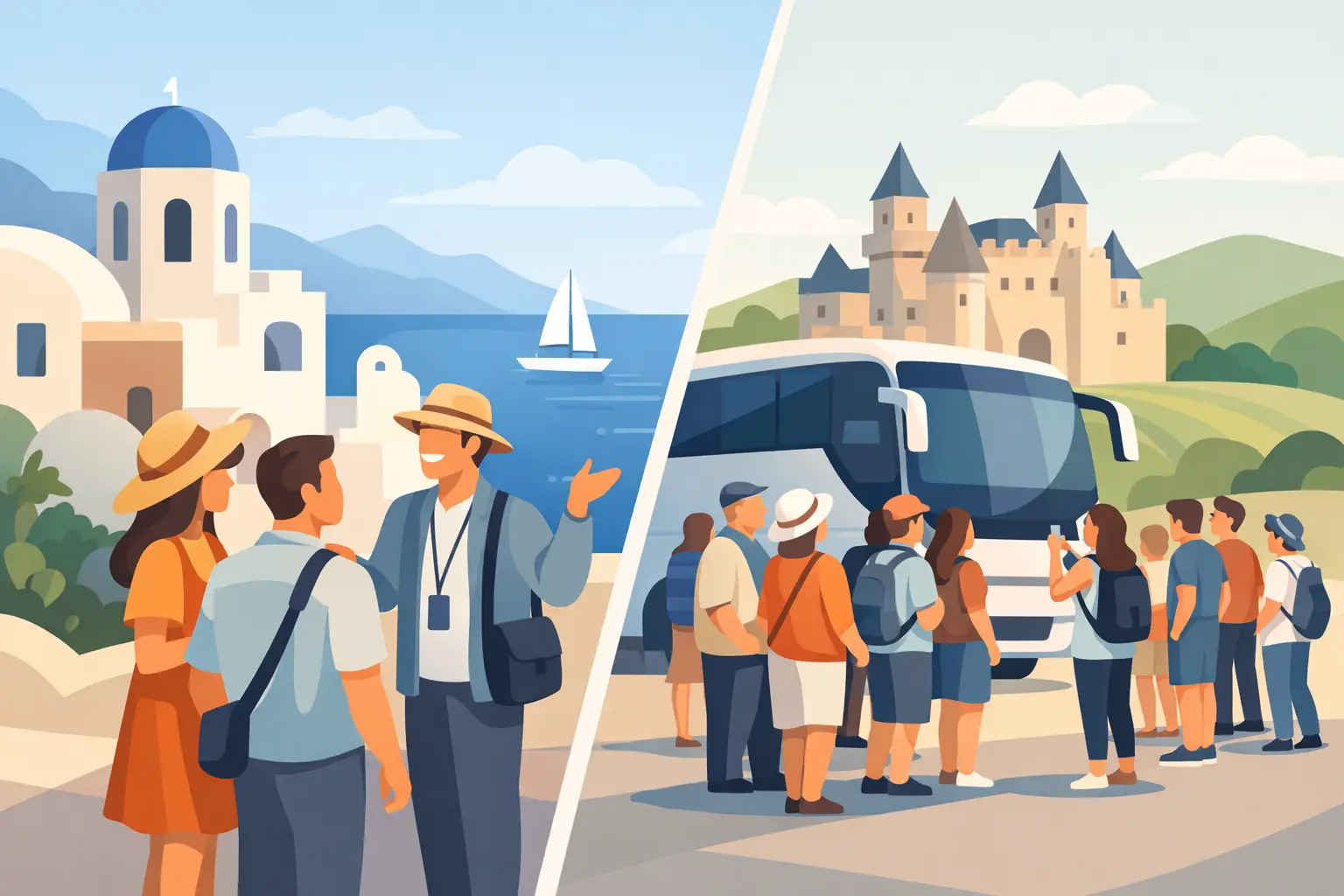
A boutique tour is generally built around a small group, often no more than 10 to 16 travelers. It favors a more personal pace and experiences that work best when the group can move lightly: a chef-led market visit, a family-run winery, a tucked-away workshop, or a conversation with a local historian.
Coach tours typically serve a larger group and use a full-size motorcoach as the primary mode of transportation. They are designed to move efficiently between major sites, often across several cities or countries. A well-run coach tour can be a practical, comfortable way to see a great deal in a limited time.
Neither format is automatically better. The right choice depends on whether you place more value on breadth, efficiency, and a lower per-person cost, or on flexibility, local connection, and the ease of traveling with a smaller circle of people.
The Group Dynamic Changes the Experience
The most immediate difference is how many people share the journey with you. On a coach tour, there may be 30, 40, or even 50 travelers. That scale can create a lively social atmosphere and may suit guests who enjoy meeting a wide range of people. It can also mean more time at hotel check-in, rest stops, restaurants, and entry points to busy attractions.
In a smaller group, the experience tends to feel more conversational. Your guide has more opportunity to learn what interests you, whether that is ancient architecture, regional cuisine, religious history, or contemporary life. Questions do not have to compete with a full bus, and fellow travelers often get to know one another naturally over shared meals and walks.
Small does not mean private, and it does not mean every detail can change on a whim. Thoughtful tour design still depends on confirmed accommodations, timed tickets, and reliable transportation. Yet a small group may be able to adjust a stop, linger when an experience is especially meaningful, or choose a more intimate dining setting when conditions allow.
Access Beyond the Main Road
Large coaches are excellent for covering distance in comfort. They are particularly useful on long touring days or routes with straightforward highway connections. If your priority is seeing several famous cities and landmarks in one trip, that efficiency is a genuine advantage.
At the same time, a full-size coach cannot easily enter every historic quarter, mountain village, alleyway, or local market. In places such as the medinas of North Africa, the old quarters of the Balkans, or compact villages in Japan, the most memorable details are often found beyond the coach parking area.
Boutique tours can use smaller vehicles when appropriate and build in more walking-based exploration. This does not mean abandoning the iconic sites. The Pyramids of Giza, the Colosseum, Angkor-era temples, and Cappadocia’s landscapes deserve their place in an itinerary. The difference is what happens around those highlights: a quieter neighborhood visit, a regional lunch, a local craft tradition, or time to understand the stories that give a monument context.
Pace: Seeing More or Experiencing More?
Coach itineraries can be ambitious. For travelers with limited vacation time, that may be exactly the point. A multi-country route can introduce you to a wide range of landscapes, capital cities, and signature sights without requiring you to coordinate trains, transfers, or hotels yourself.
The trade-off is that a packed itinerary can feel like a sequence of departures. Early bags outside the hotel door, fixed meal times, and frequent loading can leave less room for unplanned discovery. This is not necessarily poor travel design. It is simply a design that prioritizes coverage.
Boutique itineraries usually allow more breathing room. Rather than adding another attraction to the day, they may make room for a guided stroll, time in a cafe, or an afternoon with fewer scheduled commitments. Travelers who want to photograph, ask questions, browse a local market, or absorb the atmosphere of a place often appreciate this rhythm.
Still, read the daily itinerary closely. A tour labeled “small group” can be fast-paced, while some coach tours include generous free time. The itinerary itself matters as much as the category.
Comfort Is More Than a Spacious Seat
Coach tours often offer a clear comfort advantage on long drives. A large motorcoach has room for luggage, a consistent seating arrangement, climate control, and fewer vehicle changes. For travelers who prefer minimal walking or want a predictable travel day, these features can be reassuring.
Boutique touring approaches comfort differently. Smaller vehicles may feel more personal and can make shorter regional transfers easier, but they may not offer the same amount of space as a coach. On the other hand, small groups can often stay in characterful, well-located hotels that would be difficult to coordinate for a large party. They may dine in independent restaurants where a group of 40 would not fit, rather than venues chosen primarily for capacity.
Consider your own definition of comfort. If it means settling into one large coach for a long scenic drive, a coach tour may be the stronger fit. If it means a thoughtfully paced day, a central hotel, and a meal where you can hear the person across the table, a boutique experience may feel more comfortable.
Cost and Value Require a Closer Look
Coach tours are often priced lower because large groups spread operating costs across more travelers. For budget-conscious guests, that can make guided international travel more accessible. Their inclusions may also be straightforward: transportation, accommodations, select meals, sightseeing, and a tour director.
Boutique tours frequently carry a higher upfront price. Smaller vehicles, carefully selected accommodations, more specialized local experiences, and a lower guest-to-guide ratio all affect the cost. But price alone does not show the full value of a journey.
When comparing options, look beyond the headline number. Ask which meals are included, how much free time you will have, whether tipping expectations are clear, what type of hotels are used, and whether the itinerary relies on optional excursions to fill out the experience. A less expensive trip can become less compelling if it leaves out the very experiences you hoped to have.
Who Should Choose Each Style?
A coach tour can be an excellent choice for first-time international travelers, guests who want to cover substantial ground, or anyone who values an efficient, social, highly structured itinerary. It can also work well for destinations with long distances between major attractions.
A boutique tour may be better for culturally curious travelers who want a guide to be a bridge, not just a narrator. It suits couples, solo travelers, and friends who value a small-group setting, meaningful local encounters, and the confidence of a well-organized trip without feeling processed through a crowd.
For destinations rich in layered history and everyday cultural life, group size matters especially. In Egypt, Jordan, Morocco, India, Nepal, Oman, and across the Balkans, a knowledgeable local guide can turn a visit from a list of sights into a deeper understanding of place, tradition, and people.
Questions to Ask Before You Book
Do not rely on labels alone. “Boutique,” “small group,” and “premium” can mean different things from one operator to another. Confirm the maximum group size, not just the average. Ask how many guides accompany the group, what transportation is used on longer travel days, and how much of the itinerary is included in the base price.
Also ask what the company does when plans change. Clear pre-departure communication, reliable local partners, and accessible support are not glamorous details, but they matter when flights are delayed, weather shifts, or a traveler needs help. Atlas Global Tours, for example, caps groups at 10 travelers so its carefully planned journeys can remain personal while maintaining the operational care travelers expect.
The best guided tour is one that matches your travel personality. Choose the format that gives you enough structure to feel secure and enough space to be genuinely present. The most lasting souvenir may be the moment you did not rush past.